
Ancient Explorers Guide
Ancient Technology That Shouldn't Exist: 10 Artifacts That Challenge the Timeline
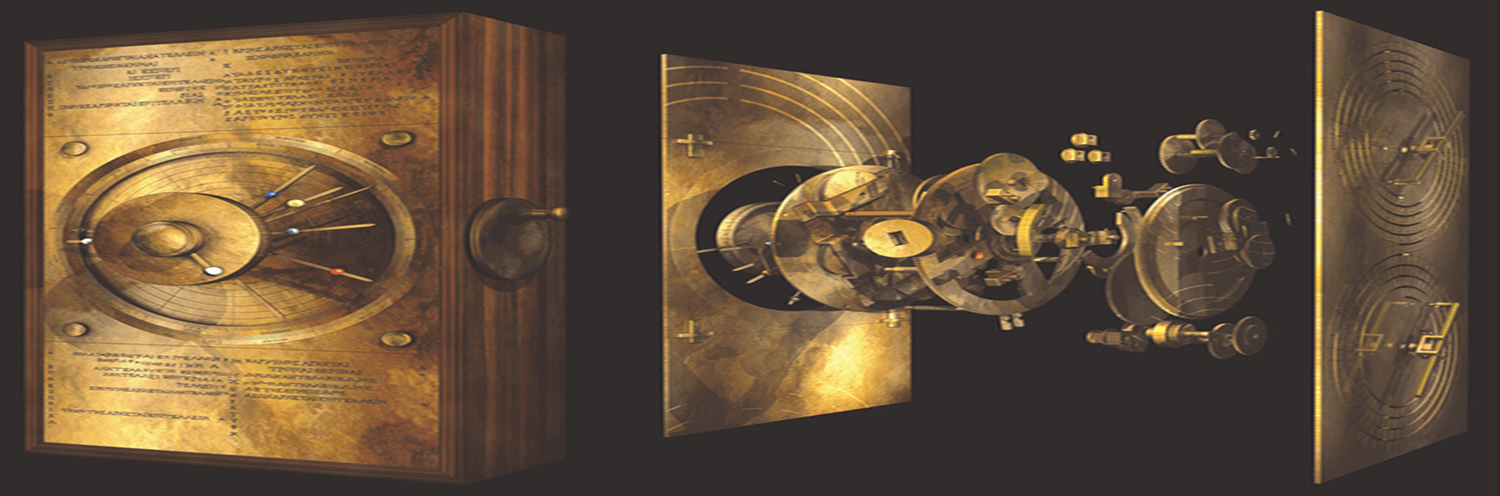
Every museum has a drawer it doesn’t quite know what to do with. An object that’s real, provably ancient — and that sits wrong in the timeline. One is a curiosity. Ten start to look like a pattern.
This guide collects the artifacts we keep coming back to: the machines, materials, and messages that suggest the ancients knew more than history gave them credit for.
The computer from the sea floor
Pulled from a Roman-era shipwreck, the Antikythera mechanism is a bronze system of precision gears that modeled the heavens — a mechanical computer built more than two thousand years ago. Nothing of comparable complexity appears in the record again for well over a millennium, and new findings keep adding to its mystery.
Sit with what that means: a technology sophisticated enough that its rediscovery took over a thousand years. Whatever workshop tradition built it — its teachers, prototypes, and repair manuals — is gone. The mechanism is proof that entire branches of ancient knowledge could vanish almost without trace.
Metal from the sky
When analysts examined the iron dagger buried with Tutankhamun, the composition told a story: the blade’s iron came from a meteorite. In an age before widespread iron smelting, Egyptian smiths were working metal that had fallen from the heavens — and they knew it was special, because they buried it with a king.
The ancients’ relationship with materials keeps surprising us. Medical researchers reconstructing a medieval remedy found it killed modern drug-resistant bacteria — a reminder that “old” and “primitive” are very different words.
The lamps that wouldn’t die
Chroniclers from antiquity through the medieval period recorded a persistent marvel: sealed tombs opened after centuries — with lamps still burning inside.
No verified ever-burning lamp sits in a museum today, and that’s exactly why the accounts matter. Either generations of writers across cultures repeated the same lie, or something real — a fuel, a chemistry, a technique — was witnessed and lost. We treat it as an open case, not a settled one. That’s the discipline hidden history demands.
Messages we still can’t read
Technology isn’t only hardware. Information is technology too — and the ancients encoded it in ways we’re still trying to crack:
- The Shigir Idol, a wooden figure dated to roughly 11,000 years old, carries geometric patterns some researchers read as encrypted code — symbolic communication millennia before the first cities.
- The Phaistos Disk resisted every decipherment attempt for a century; now some scientists claim they’ve finally cracked its code.
- The story of the world’s oldest writing keeps being pushed earlier, and stranger — while claims like Egyptian hieroglyphs found in Australia test our ability to tell genuine anomaly from modern hoax.
- Even ancient art may carry mathematics we only formalized recently — see the sine wave in ancient context.
The mundane genius
Not every lost technology is exotic. Some of the most telling artifacts are bureaucratic: Egypt’s nilometers — ancient devices for calculating taxes from the Nile’s flood height — are administrative instruments of a civilization running on data. And sometimes an object is simply centuries ahead of its category, like the 1,200-year-old “phone” in the Smithsonian’s collections, an acoustic device from the Chimú culture.
Genius that routine doesn’t appear from nowhere. It implies deep traditions of accumulated knowledge — most of which never survived to reach us.
Reading the pattern honestly
Where does this leave us? Between two mistakes.
The first mistake is the debunker’s reflex: every anomaly must be a hoax, a coincidence, an exaggeration. The second is the believer’s reflex: every anomaly proves the theory — and some stories, like the declassified “Nazi Bell time machine” documents, deserve far more skepticism than they usually get.
The honest position is the explorer’s: the artifacts above are real puzzle pieces, the picture on the box is missing, and the only way forward is more evidence. If the idea that whole ages of knowledge can be lost — and found again — pulls at you, that’s the thread our free Ancient India Uncovered web series follows all the way down to a city on the floor of the Arabian sea.
Frequently asked questions
What is the most mysterious ancient technology ever found?
The Antikythera mechanism is the strongest single case: a geared astronomical computer from ancient Greece whose sophistication wasn't matched again for well over a thousand years. Unlike many claimed artifacts, it is physically real, extensively studied, and still yielding new findings.
Was Tutankhamun's dagger really made from a meteorite?
Analysis of the iron dagger found with Tutankhamun showed a composition consistent with meteoritic iron — metal from the sky, worked in an age before iron smelting was widespread. It shows ancient metallurgists prized and worked materials we assumed were beyond them.
What were the ever-burning lamps?
Accounts from antiquity through the medieval period describe lamps found in sealed tombs still burning after centuries. No verified ever-burning lamp survives today, so they remain a genuine open question: exaggeration, misunderstanding — or a lost technique.
What is the oldest writing in the world?
The earliest known writing systems emerged in Mesopotamia, but the story keeps getting more interesting: objects like the Shigir Idol — wooden, carved with geometric code-like patterns, and dated to roughly 11,000 years old — suggest symbolic communication far older than the first cities.
Go beyond reading — watch the discoveries unfold.
Watch the free Ancient India Uncovered web series →