
Ancient Explorers Guide
Dwarka: India's Atlantis — The Sunken City That Could Rewrite History
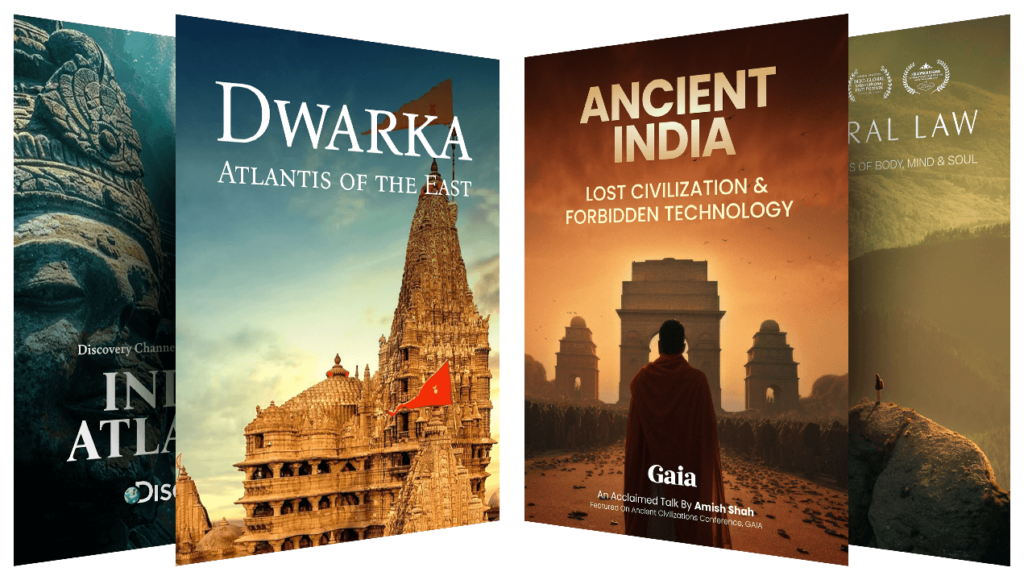
Before it sank to the bottom of the sea, the city of Dwarka is said to have been one of the most advanced places on Earth. The Mahabharata describes it as the fortress city of Krishna — golden, planned, impossibly grand — and tells of the ocean swallowing it whole. For most of modern history, that was filed away as myth.
Then explorers started finding things underwater.
The city beneath the Arabian sea
Off the coast of modern Dwarka, in the western Indian state of Gujarat, marine explorations have reported walls, streets, and man-made structures resting on the seafloor. Further south, surveys in the Gulf of Cambay described submerged man-made structures with material dated to roughly 9,500 years ago — a date that, if it held for a planned settlement, would sit thousands of years before the cities of Mesopotamia.
India’s own oceanographic institutions have been part of this story: sonar surveys and dives that mapped what appears to be a lost city off the Indian coast, with geometric regularity that is difficult to explain as natural formation.
So the question stops being “did the ancients invent a sunken city?” and becomes something far more interesting: what exactly is down there — and why don’t we know more about it?
What the Mahabharata actually says
The Mahabharata is not vague about Dwarka. It describes a coastal city built on reclaimed land, organized into precincts, protected by fortifications — and it describes its end: the sea rising to reclaim it after Krishna’s departure.
Ancient texts describing a real coastal flood is not, by itself, extraordinary. Coastlines moved dramatically as the last Ice Age ended, and sea levels rose hundreds of feet worldwide. What makes Dwarka special is the possibility that a specific city, remembered in a specific text, may correspond to specific ruins in the exact place the text remembers it.
That’s not mythology versus archaeology. That’s mythology as a map.
Flying machines and forbidden technology
The same body of literature that remembers Dwarka also describes vimanas — flying machines — and weapons of terrifying power. Skeptics read those passages as poetry. Others ask why a bronze-age text needed such precise imagery for things its authors supposedly couldn’t imagine.
We’ve explored this question from many angles, including the viral claim that an ancient vimana was unearthed in 2012 — a story worth reading precisely because separating evidence from internet legend is the whole discipline of hidden history. We follow the evidence, and we say so when a story doesn’t survive scrutiny.
But the deeper pattern stands on firmer ground: ancient India’s knowledge base was extraordinary. From mathematics to metallurgy to city planning, the achievements of ancient India keep forcing historians to push dates earlier and capabilities higher. Modern tools are accelerating this: laser scanning teams are now digitally preserving ancient Indian landmarks in millimeter detail, and excavations like the Buddhist monastery unearthed at Vadnagar keep adding layers to the subcontinent’s story — including its astonishing cultural reach, all the way to the Greco-Buddhist fusion that followed Alexander’s armies home.
Why is Dwarka still unexplored?
Here is the part that keeps explorers up at night: the underwater site remains largely off-limits. Permissions for expeditions are rare, and full-scale excavation of the submerged structures has never happened. Whatever sits on that seafloor has been studied less than the surface of the Moon.
When our documentary Dwarka: Atlantis of the East was released, it struck a nerve — over 7 million people on every continent watched it, and Discovery Channel’s Expedition Unknown funded a return to Dwarka to dive deeper into the mystery. What was uncovered through that collaboration shocked even the skeptics.
See it for yourself
Reading about a sunken city is one thing. Watching the dive is another.
Both films — our original Dwarka: Atlantis of the East and the Discovery Channel Expedition Unknown: India’s Atlantis collaboration — are free to watch as chapters one and two of the Ancient India Uncovered web series. If the questions in this guide pulled at you, that’s where they lead.
Frequently asked questions
What is Dwarka?
Dwarka is an ancient city on India's western coast, described in the Mahabharata as the legendary city of Krishna. Marine explorations off the coast of modern Dwarka and in the Gulf of Cambay have reported submerged structures that some researchers associate with the city of the texts — which is why it is often called India's Atlantis.
Was the sunken city of Dwarka really found?
Marine surveys off India's western coast have reported man-made structures on the seafloor, with some dating estimates reaching thousands of years into the past. What exactly the structures are — and how old — remains debated, which is precisely what makes Dwarka one of archaeology's most compelling open questions.
How old is Dwarka said to be?
Reports on the submerged structures near Dwaraka have described material dated to roughly 9,500 years ago. If those dates held for a planned city, it would predate the conventional timeline for urban civilization — one reason mainstream archaeology treats the claims cautiously.
Where can I watch the Dwarka documentary?
Ancient Explorers' documentary 'Dwarka: Atlantis of the East' — watched by over 7 million people — is available free as chapter one of the Ancient India Uncovered web series at ancientexplorers.com/optin/.
Go beyond reading — watch the discoveries unfold.
Watch the free Ancient India Uncovered web series →